Nephi Bingo app icon, a brass compass on a night-blue ground

// trivia by firelight

With testers · iPhone

Want to try it early? Ask for a spot on the beta list. Not everyone gets one, but we'd like to hear from you.

Bingo, with a story behind every call.

A trivia bingo game for Latter-day Saint families, Primary, youth and anyone studying together. One phone calls, everyone plays a card, and the whole room guesses aloud. It is free, it needs no account, and it needs no internet.

  • NNames
  • EEvents
  • PPlaces
  • HHeritage
  • IItems

For a family night, a class, or a quiet Sunday.

Tell it who is playing, from Primary to a study group, and it picks clues to suit. Or play on your own against pretend rivals.

  • 🏠Family home eveningA lesson that plays like a game. Hints help the little ones, and a call you miss chasing the toddler is stamped for you.
  • 🧑‍🏫Primary and youthRehearse at home with pretend players, then call for the class. Youth join on their own iPhones, with no sign-ups.
  • 📖Study groupsStudy It leaves each answer up twice as long, and every scripture square gives its reference, so you can turn to the verses.
  • 🌐Bilingual familiesEach phone picks English, Español, Português or Filipino for the clues, and the whole room still plays one game.

A clue on every ball.

A glass tumbler turns over a night sea, and a lettered ball drops into the tray. The letter is the column; the clue is a name, an event, a place, a piece of heritage or an item. Guess it, find it on your card, stamp it. Finish the pattern and nobody has to shout: Bingo calls itself.

How a game goes.

  1. The card.Five columns spell N·E·P·H·I, with a free square in the middle. Or pick the Quick 3×3, which mixes the five and marks each square with a colored strip. On a 5×5 card at the Standard length, a round draws from 45 balls, nine a column; 35 at Quick and 60 at Long.Standard 5×5 · Quick 3×3
  2. The spin.The first ball of each round waits for the caller: a kickoff card showing the shape that wins, or Start the game! for a room's host. Then the caller's phone counts three, two, one, and every phone in the room gets the long first spin. After that the phone calls the rest at the pace you chose, or waits for a tap if you call by hand.Spin the first ball
  3. The clue.In Guess It the clue comes first, and the bulbs round your card count down your thinking time, then a hint and more time, then the answer. Just Play shows the answer at once. In any mode, the story behind the call, its references and a Prove It question are one tap away under The story. Study It leaves each answer up twice as long, and opens the story by itself on a phone that calls without playing a card.THINK IT OVER · HINT · HERE IT COMES
  4. Your move.The call's column lights up (on a Quick card, its squares do) and the rest of the card dims. Tap the square to stamp it. Only a called square takes ink, and a wrong one buzzes. If the call is not on your card, there is nothing to find: a second after the answer shows, the phone stamps NOT ON YOUR CARD across the card and says so beside the answer.Not called yet. Keep looking!
  5. Missed one?When the next ball drops, anything already called and still unmarked is stamped for you in brass, so a clue you did not hear never costs you the game. It is a switch in Settings, and it starts on.Mark missed calls for me
  6. Bingo!The moment the calls complete your pattern, your phone claims it. The host's phone checks the claim against the calls, never against taps, and then the confetti.Bingo calls itself.

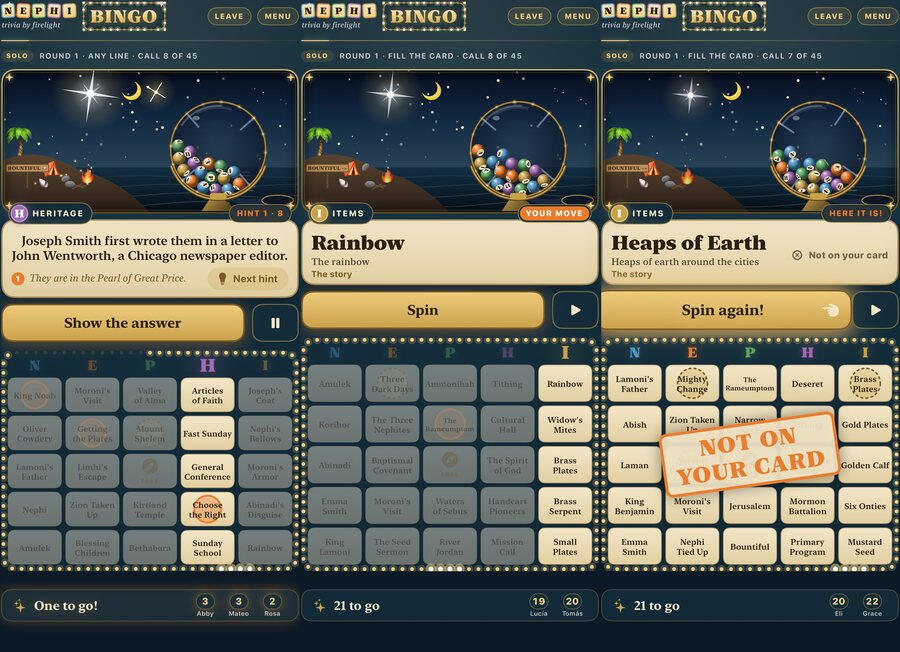
A call, in three screens.

  1. The clue.A Heritage ball and a hint. Only the H column stays lit. One to go.
  2. Your move.Rainbow, top of the lit I column. Tap it to stamp it.
  3. Not on your card.The phone says so a second after the answer. Spin again! is right there.

Three moments, each from a different game of Play Solo against pretend rivals.

Play in the same room.

Four buttons on the first screen, and two of them never touch a network at all.

  • Play SoloThe phone calls and you play a card, racing pretend rivals who live on your phone. Stamp the newest call, or let the phone tell you it is not on your card, and Spin again! is right there.The phone calls. You play a card.
  • Host GameYour phone calls for the room and shows a six-digit PIN. Play along on the same phone, or just call.Your phone calls for the room.
  • Join GamePick the game under GAMES NEARBY with a tap, or type the PIN from the host's screen, and You're in!Play a card on this phone.
  • Practice HostingCall a game to four, eight or twelve pretend players, one of whom may call Bingo a little early, before you call one for real.Call a game to pretend players.

A room plays over its Wi-Fi or directly phone to phone, and needs no internet either way. Each phone asks once for Local Network permission, and nobody makes an account. The host can take back the last call, pause, and end the round or the game. If the host's phone goes quiet for 12 seconds, anyone can Take over hosting and the game carries on from the last call, and whoever started it can always take it back. Latecomers are welcome, with every earlier call counted, and can win once one more call has been made after they join and its answer is up.

The PIN is a meeting point, not a password. Turn off Show the PIN to phones nearby and nearby phones type it from the host's screen instead of joining with a tap; the game's announcement then carries nothing that gives the PIN away, and the switch stays off until you turn it back on. Either way, the host's phone sends the game itself only to the phones it has let in.

Names, Events, Places, Heritage, Items.

Two hundred clues in five columns, each with an answer, two ways of asking, three hints, the story behind it and a Prove It question, and every scripture square gives its reference. Most are scripture; the rest are history, culture and two just for fun.

  • NNames42 squaresEnos, Laban, Moroni, Korihor, Noah
  • EEvents41 squaresPeace, Be Still; Burying the Swords; Nephi Tied Up
  • PPlaces39 squaresBountiful, Irreantum, Garden of Eden, Kirtland Temple
  • HHeritage34 squaresRelief Society, Ministering, Tithing, All Is Well
  • IItems44 squaresGold Plates, The 116 Pages, Nephi's Bellows, Moroni's Armor

Real squares from the game. On a standard card, a little over half come from the Book of Mormon, about a third from the rest of scripture and Church knowledge, and the rest from culture.

  • Primary · Youth · Family · Study
  • 5×5 or 3×3
  • any line · two lines · four corners
  • the X · the plus · postage stamp · the frame
  • fill the card
  • Just Play · Guess It · Study It
  • by hand · relaxed · steady · brisk

Pick who is playing and the clues are chosen to suit: all 200 for Family, 197 for Youth, 194 for Study, 145 for Primary.

How the clues were checked: every scripture reference was found in the Church's own editions in English, Spanish and Portuguese, and in Tagalog wherever the Church publishes that book in Tagalog; for the Bible, which it does not, the Tagalog names were checked against the Church's Tagalog study pages instead. Each square's key phrases were found in the English of the verses or Church page it rests on, apart from four everyday squares such as the missionary name tag, and every translated name is spelled the way the Church spells it in that language. Clues mostly paraphrase, and a quote is a line at most. Those are careful checks. They are not anyone's official approval.

Four languages, one game.

Clues, answers, hints and stories come in English, Español, Português or Filipino, and each phone picks its own, starting with the phone's own language when it is one of the four. Every phone plays the same game whatever its language, so one room can play in four. The N·E·P·H·I letters stay put; the column names and the scripture book names change.

NEPHI
EnglishNamesEventsPlacesHeritageItems
EspañolNombresEventosLugaresHerenciaObjetos
PortuguêsNomesEventosLugaresHerançaItens
FilipinoMga PangalanMga PangyayariMga LugarPamanaMga Bagay

The menus and buttons are in English for now. No native speaker has read the Spanish, Portuguese or Filipino clues yet, so if a line reads wrong, tell us which one. Foods only Americans would know were left out on purpose.

An independent game.

Nephi Bingo is an independent game. It is not made, sponsored or endorsed by The Church of Jesus Christ of Latter-day Saints. Clues mostly paraphrase the scriptures, and every scripture square gives its reference, so you can read the verses yourself.

What it costs.

Free, and complete.Every mode, both card sizes, all 200 clues in all four languages, hosting a room and joining one. No ads, no account, and nothing for sale in this version.

Your game stays with you.

Your name, your settings and the game in progress are kept on your own iPhone. There is no account and no server of ours for anything to go to. When you play with other phones, this is what travels between them:

WhenWhat leaves your phoneWhere it goes
Play Solo, Practice HostingNothing. They use no network at allNowhere
You look for a gameA question: which phones nearby are hosting Nephi Bingo. Nothing about youThe local network
You host a gameThe game's announcement: your name, a random player ID, a code for the game, and the PIN's six digits while Show the PIN is on. With it off, nothing in it gives the PIN awayAny device on the same Wi-Fi, or any Apple device near enough for the phone-to-phone link, that looks for it
You join a gameYour name, player ID and the PINThe game you tapped. If you type the PIN instead, the game showing that PIN, or else every game nearby that keeps its PIN hidden; only the right host answers
You play in a roomThe host's copy of the game: every player's name and player ID, the PIN, the seed every card is made from, the calls and the winsThe phones the host has let into that game
You get Bingo in a roomYour player ID and the round. Never your marksThe host's phone

Between phones it is plain local-network traffic, not encrypted. None of it reaches us, the app has no analytics and no advertising identifier, and the whole list, message by message, is in the privacy policy below.

  • We never sell personal data. Not aggregated, not anonymized, not to a broker, and the standard every feature is held to is the least data it needs to do the job you asked for.
  • Leaving is easy. Leave ends your part in a game and deletes this phone's saved copy; deleting the app removes the rest from your phone. Your name and player ID stay in that game's copy on the other phones, marked as gone, until they leave it or start a new one.

Nephi Bingo is not on the App Store yet. It goes to a small group of testers first, and this page will say when it is out.

Nephi Bingo — Support

Trivia bingo for the whole room, on the phones already in it.

Most of the game explains itself once the first ball drops, and the app's own How to play sheet is one tap from the first screen. This page answers the questions a first player or a first-time host tends to ask. Anything else, write to us using the form below.

Or just write to us.

There is one person behind this game, and he reads everything that comes through this form. Two kinds of message are welcome, and both arrive in the same place:

  • Something is wrong with the app. Tell us which screen, what you tapped, and what you expected instead. If it happened in a room, say how many phones were playing.
  • A clue is wrong. A reference that does not say what the clue says, a misspelled name, or a line that reads badly in Spanish, Portuguese or Filipino. Tell us the answer on the square and the language.

Your name, your email address and your message are emailed to the shop. They are used to answer you and nothing else. The full account is in the privacy policy below.
Common questions

How do we all get into one game?
One phone taps Host Game, then Open the game, and its screen shows JOIN WITH PIN and six digits. Everyone else taps Join Game and either taps the game under GAMES NEARBY or types the six digits under OR TYPE THE PIN. It works over the room's Wi-Fi or directly phone to phone, and needs no internet. Nobody makes an account; the name on the Join screen is the one the room sees.
The game says Needs the PIN. Why?
Because the host turned off Show the PIN to phones nearby in Settings. With it on, nearby phones join with a tap; with it off, the game still shows up, and a tap asks for the six digits from the host's screen. The switch stays the way the host left it. Off, the game's announcement carries nothing that gives the PIN away; either way, the host's phone sends the game only to the phones it has let in. The PIN has nothing to do with which cards anyone gets.
It says No game found.
Check the six digits against the host's screen, and that the host's game is open. Both phones need Local Network permission (below), and they need to share a Wi-Fi network or be close enough to reach each other directly. If it says That game needs a newer Nephi Bingo, update the app, then join.
Why does it ask for Local Network?
That is how phones in the same room find each other. iOS asks the first time you open a game as host or tap Join Game, in the app's words: "Nephi Bingo looks for games on phones nearby, over this Wi-Fi or phone to phone, so everyone in the room can play together." Play Solo and Practice Hosting never ask, because they use no network. If you said no, turn it on in Settings, Privacy & Security, Local Network, then try again.
What if a phone drops out?
The room knows each phone by a random player ID made when the app was first opened, so a phone that drops out is recognized when it comes back, and its card, which is worked out from that ID, is the same card. If the app itself was closed, open it again within three minutes and it picks up the game where it was. Leave a game for three minutes or more, in the background or closed, and it is over for your phone: the app goes back to Home and says why, and in a room you tap Join Game to play again. While a game is on, the screen stays awake.
What if it is the host's phone?
After 12 seconds of silence, every player sees The host has gone quiet. and a Take over hosting button. Whoever taps it calls the rest, from the last call. Whoever started the game can always take it back. A host who needs to go can choose End the game for everyone or Leave, and let someone take over.
Can someone join after we have started?
Yes. Every call made before they arrived counts on their card, and they can win once one more call has been made after they join and its answer is up, so nobody wins the moment they walk in.
Why will a square not take my stamp?
Because it has not been called. The app checks every stamp: only a called square takes ink, and a wrong one buzzes Not called yet. Keep looking! While a clue is still up, stamping the clue's own square counts as guessing it, and a square that has not been called says Not that one. Keep thinking! A stamp is never taken back.
What if the call is not on my card?
You do not have to do anything. About a second after the answer shows, the phone stamps NOT ON YOUR CARD across your card and writes Not on your card beside the answer, so nobody hunts for a square that is not there. In Play Solo the next ball then comes a few seconds later, unless you call by hand or play Study It, and Spin again! is lit if you would rather not wait.
I missed a call. Have I lost?
No. When the next ball drops, anything already called and still unmarked is stamped for you in dashed brass, so you can tell it from your own stamps. That is Mark missed calls for me in Settings, and it starts on. Spotting help, also on, outlines called squares you have not stamped. The newest call is yours to find: if it is on your card and still unstamped, its square starts to pulse five seconds after its answer shows.
Do I shout Bingo?
You can, but the phone does it for you. The moment the calls complete your pattern, it claims Bingo, and the host's phone checks the claim against the calls, never against which squares were tapped. The line under your card says how close you are: 3 to go, One to go!, then BINGO! You won this round.
The calls are too fast, or too slow.
Change the pace under Change the game before you start. Relaxed gives 20 seconds to think and 10 for each hint, Steady 14 and 8, Brisk 9 and 5; after the answer, the next ball comes in 20, 12 or 8 seconds. By hand means nothing moves until the caller taps. Any time, tap to jump ahead, or pause.
No sound?
The sounds and the music follow the ringer switch. Turn on Play with the ringer off in Settings to hear them with it off. Sounds, Background music and Haptics each have their own switch. Every sound is made by the app itself, and the music, Night Camp, was made for the game.
Can phones in different languages play together?
Yes. Each phone picks the language of its clues and answers in Settings (English, Español, Português or Filipino), and every phone plays the same game whatever its language. The menus are in English for now. No native speaker has read the Spanish, Portuguese or Filipino clues yet, so if one reads wrong, tell us which.
Does it work on iPad or Mac?
Not in this version. It is for iPhone, on iOS 26 or later, held upright.
Is Nephi Bingo made by the Church?
No. Nephi Bingo is an independent game. It is not made, sponsored or endorsed by The Church of Jesus Christ of Latter-day Saints. Clues mostly paraphrase the scriptures, and every scripture square gives its reference, so you can read the verses yourself.
Does the app track me or show ads?
No analytics, no tracking, no advertising identifier, no ads and no account. What travels between phones in a game, message by message, is listed in the privacy policy.

Nephi Bingo — Privacy Policy

Last updated September 25, 2026

Nephi Bingo has no account and no Nephi Bingo server. What you put in it, your name and your settings, and the game you are playing are kept on your own iPhone. The app itself sends nothing to us; there is no server of ours for it to send to. If you test it through TestFlight, or have turned on Share With App Developers in your iPhone's settings, Apple passes crash reports on to the developer, as it does for every app. Nothing about you is sold.

The game is made to be played by several phones in one room, so rather than claim that nothing ever leaves the phone, this page lists every message that does, what it carries, and who can receive it. All of it goes over the local network to nearby phones, and only when you host a game or join one.

What the app stores, and where

These are kept in the app's own storage on your iPhone. Like any app's data, they are part of your phone's own backup to iCloud or a computer, if you make one.

  • A player ID: a random number made the first time the app opens. It says nothing about you and is not an identifier Apple issues. It is how a room recognizes your phone when it drops out and comes back, and your card in a game is worked out from it.
  • Your name, as you typed it in Settings, on the Join screen or in the host's setup. Until you change it, it is Player. Up to 40 characters of it are shown in a game.
  • The language you chose for clues and answers.
  • How you last set up a game, so the next one starts the same way, and your switches in Settings: spotting help, missed-call marking, sounds, music, the ringer, haptics, Show the PIN to phones nearby, and whether you have seen the first-game tips.
  • The game in progress, saved after every change in Play Solo, Practice Hosting or a room (and at least every half minute), with the time it was saved, so it can carry on if the app is closed and opened again within three minutes. In a room that copy includes what every phone in the game receives (below): every player's name and player ID, the PIN and the seed the cards are made from. It also holds your own marks. It is deleted when you tap Leave, when a new game starts, and when the game has been left for three minutes or more.
  • The clues come inside the app. Nothing is downloaded.
  • Deleting the app removes everything it kept on the device.

Permissions the app may ask for

  • Local Network, in these words: "Nephi Bingo looks for games on phones nearby, over this Wi-Fi or phone to phone, so everyone in the room can play together." iOS asks the first time you open a game as host or tap Join Game. Play Solo and Practice Hosting never ask, because they use no network at all. If you say no, the app tells you where to turn it on: Settings, Privacy & Security, Local Network.
  • Nothing else. The app does not ask for your location, contacts, camera, photos, microphone, speech, health data or notifications, and it never asks to track you.

Everything that leaves your device

This is the complete list. None of it happens in Play Solo or Practice Hosting, where the pretend players live on your phone. In a room, phones talk over the room's Wi-Fi or directly phone to phone over Apple's peer-to-peer link, which the app keeps on whether or not there is Wi-Fi. The connection is plain TCP and is not encrypted, so anyone able to watch that local network could read these messages. None of them goes to the internet, and none reaches us.

  • Looking for games: while you are on the Join screen or in a room, your phone asks the local network which phones are announcing a Nephi Bingo game, so it can find the game and its host. The question carries nothing about you.
  • The game's announcement, while your phone hosts a game (or has taken over hosting one). Any device on the same Wi-Fi, or any Apple device near enough for the phone-to-phone link, that looks for it can read it, not only Nephi Bingo. It carries: your name as host (up to 40 characters), your player ID, a code for the game worked out one way from its hidden seed, a random label for the announcement, which game it is and the announcement's format number, and the PIN's six digits whenever Show the PIN to phones nearby is on, which it is until you turn it off. With it off, nothing in the announcement is worked out from the PIN.
  • Hello: the moment two phones connect, each sends the other its player ID and name, before any PIN is checked.
  • Asking to join: the PIN, your player ID, your name, that you are joining as a player, and which versions of the game and its clues your phone has. It goes to the game you tapped. If you type the PIN instead, it goes to the game whose announcement shows those six digits, or, if none does, to every game nearby that keeps its PIN hidden; your phone connects to each of them, so each also gets your hello, and the hosts whose PIN it is not ignore it. It is sent again every second and a half until the host answers.
  • A refusal: if the host cannot let a phone with the right PIN in, because the game is over, joining is closed or the phone needs an update, it says which, with that phone's player ID.
  • The game itself: the host sends each phone a whole copy of the shared game, once it lets that phone in and again after every change (each call, answer, taken-back call, round, pause and new player). The copy holds the hidden seed and the question set, so every phone can work out every card; the host's and the starter's player IDs; the PIN; the room's settings; every player's name, player ID and when they joined, including anyone who has left; and each round's calls and wins. It goes only to the phones the host has let in: a phone that has connected without the right PIN gets none of it. Players send their copy back to the host when they know something it does not, and after the app reopens.
  • A Bingo: your player ID and the round number, sent by your phone the moment the calls complete your pattern, and again every three seconds until the host answers. Your marks never leave your phone: the host checks a Bingo against the calls, not against what you tapped.
  • The verdict: the host tells the room whose Bingo it was, which round, and the call it was confirmed on, or which squares were still missing.
  • The host's heartbeat, every two seconds, to the phones in the game: the game's code, who is hosting, a short fingerprint of the game's state, and a short tag worked out from the PIN, which those phones already have.
  • Leaving: when you tap Leave, your player ID, to the host, which marks you as gone. Your name stays in the game's copy for the rest of that game.

Your stamps, your taps, your switches in Settings and the language you play in are not sent. The app has no analytics, no advertising or crash-reporting SDK, no advertising identifier, and no third-party tracking. It reads no identifier from your device beyond the random player ID it made itself.

The other players

Everyone in a game sees every player's name, and any phone in the game can work out every card, because the cards come from the game's shared seed. The host, and a solo player about their pretend rivals, sees how many squares each player still needs. So choose a name you are happy for the room to see; a first name or a nickname is plenty. The PIN is a meeting point, not a password. With Show the PIN to phones nearby on, its six digits are in the announcement and nearby phones join with a tap. With it off, the announcement carries nothing worked out from the PIN, people type the digits from the host's screen, and the host's copy of the game, PIN included, goes only to the phones it lets in. Anyone who has the six digits can still ask to join.

What is never done

Nothing about you, or about the people you play with, is sold, rented, or handed to a data broker: not aggregated, not anonymized, not “with a trusted partner”. There is no account, no profile and no server of ours in this game. No AI model runs in the app; the clues are fixed text that ships inside it.

The two rules behind all of this

Everything above is what this version does today, and it can be checked. These two are the standard the next decision gets held to:

  1. Nothing about you is sold, rented, or handed to a data broker.
  2. Only the least data a feature needs to work, and only for that feature. If something has to leave your device to do a job you asked for, it is the smallest thing that does the job, it is named on this page, and it is not kept or used for anything else.

Two flows above do not meet the second rule yet: the name in the hello, which the other phone never uses, and the name in a request to join that goes, with a typed PIN, to hosts whose PIN it is not.

If this app ever needs a third-party service, or a kind of data it does not take today, that choice gets made for the person using it rather than for the revenue, it will be described here before it ships, and it will be switchable off wherever it can be.

Purchases

Nephi Bingo is free, and complete. This version has nothing to buy and shows no ads.

Children

Nephi Bingo is made for families, and one of its settings chooses clues for Primary. Nothing a child types or taps in it is sent to us by the app. A child's name, like anyone's, is seen by the other phones in the game, and a host's name is in the game's announcement, so a first name or a nickname is the right thing to type.

Changes

If this policy ever changes, the updated version will be posted at this address with a new date at the top.

Writing in

Contact is a form on this page rather than an email address. What you type into it (your name, your email address and your message) is emailed to The Butcher Shop LLC by the service that hosts this website, and that service's own privacy policy covers the delivery. The message is used to answer you, and the reply comes from the person who made the app. The app itself has no part in this: it sends nothing when you write in, and nothing you say in the form is joined to anything in the app.

Contact

Questions about privacy in Nephi Bingo: Send us a message.